What is Aluminum Cladding Panels?
When contractors call us asking for "aluminum cladding panels," we always ask back: "Which type?" Most people don't realize they're requesting a system category, not a single product—and that confusion costs projects thousands in rework.
Aluminum cladding panels are exterior building envelope systems made from aluminum-based materials, available in three structurally distinct types: solid aluminum sheets, aluminum composite panels (ACP), and aluminum honeycomb panels. Each type has different load-bearing capacity, fire ratings, and installation requirements, making the selection process a structural decision rather than just an aesthetic choice.

"Different types of aluminum cladding panels"
Here's the problem we see repeatedly: A distributor receives an architectural drawing specifying "4mm aluminum cladding" and quotes ACP pricing, but the project actually requires solid aluminum for fire safety compliance. The mismatch gets discovered during installation, forcing material replacement and schedule delays. This article breaks down the structural differences that determine which panel type your project actually needs.
Why Does Panel Type Matter More Than Finish?
Most RFQs focus on color, texture, and size. But in our 14 years handling facade projects, we've learned the hard way that decorative specifications are secondary considerations.
Panel type determines three project-critical factors: structural integrity under wind load, fire safety certification requirements, and installation system compatibility. Choosing the wrong type means either over-engineering (wasting budget) or under-specifying (failing inspections).
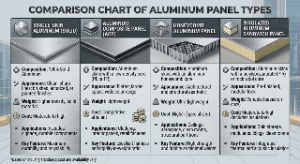
"Structural differences between aluminum cladding types"
The Real Selection Variables
When customers approach us with project specs, we ask four questions before discussing finishes:
Fire rating requirements: High-rise residential buildings in EU markets need A2-s1,d0 non-combustible certification. Standard ACP with polyethylene core can't achieve this rating—you need solid aluminum sheet or mineral-filled composite panels. The cost difference is 30-40%, but there's no workaround if local codes require it.
Wind load zone: Projects in coastal areas or high-rise applications face wind pressures exceeding 2.4 kPa[^1]. A 3mm solid aluminum sheet handles this load differently than a 4mm ACP with the same face thickness. We've seen panels that looked identical in samples perform completely differently during typhoon season because the structural calculation was based on appearance rather than engineering data.
Existing support structure: If you're retrofitting an old building with lightweight steel framing, the subframe may not support the weight of solid aluminum panels (8.5 kg/m² for 3mm thickness). You'd need ACP (around 5.5 kg/m² for 4mm total thickness) or face expensive structural reinforcement. We ask customers to provide subframe load capacity before quoting—it changes the entire material selection.
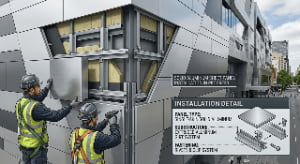
Installation system: Each panel type requires specific fastener types, spacing, and sealing methods. Solid sheets typically use concealed fixing systems with clips, while ACP uses different cassette or rivet systems. If you order panels without confirming system compatibility with your installer, you'll discover during installation that mounting hardware doesn't match panel profiles.
| Selection Factor | Why It Determines Panel Type | Cost Impact If Ignored |
|---|---|---|
| Fire rating | Core material must meet A1/A2 for high-rise | 30-40% material replacement + testing |
| Wind load | Face thickness ≠ structural capacity | Panel failure or unnecessary overdesign |
| Support structure | Weight varies 3-12 kg/m² between types | Subframe reinforcement or re-engineering |
| Installation system | Fixing methods differ by panel construction | Incompatible hardware = installation delays |
What Are Solid Aluminum Sheets and When Do You Need Them?
Solid aluminum sheets are exactly what the name suggests: single-layer aluminum plates, typically 2-5mm thick, with no composite core or bonded layers.
Solid aluminum sheets provide maximum fire safety (A1 non-combustible rating) and highest structural strength, making them required for high-rise residential facades in strict fire code regions and projects needing long-span panel installations without intermediate support.
"Solid aluminum cladding sheet structure"
When Projects Actually Need Solid Sheets
We manufacture solid sheets in our 6000 sqm facility, and these inquiries follow predictable patterns:
High-rise residential in EU/UK markets: After the Grenfell Tower fire, regulations tightened dramatically[^2]. Projects over 18 meters in UK or classified as high-rise residential in EU need A1 or A2-s1,d0 rated materials[^3]. Solid aluminum automatically qualifies as A1 (completely non-combustible) without additional testing. No composite panel with plastic core can match this—even mineral-filled cores only reach A2 rating.
Long-span facades without dense subframe: When architectural design calls for large panel dimensions (1500mm x 4000mm or larger) with minimal visible support, solid sheets handle the structural load better. In a recent commercial project, the architect wanted clean horizontal lines with support only at floor levels (3.6m spans). We specified 4mm solid sheets because ACP would require mid-span stiffeners, breaking the design aesthetic.
Corrosive environments: Coastal projects or industrial areas with chemical exposure need the durability of solid aluminum. There's no bonded layer that could delaminate under constant salt spray or acidic conditions. We've supplied solid sheets to seaside hotels in Southeast Asia where ACP panels on older buildings showed edge delamination after 5-7 years.
The tradeoff is cost and weight. A 3mm solid aluminum sheet weighs approximately 8.1 kg/m² (aluminum density 2.7 g/cm³[^4]), while a 4mm ACP with 0.5mm skins weighs around 5.5 kg/m². Installation requires heavier-duty subframes, and material cost runs 40-60% higher than equivalent ACP. But when fire codes or structural requirements demand it, there's no substitute.
| Solid Sheet Spec | Typical Application | Key Limitation |
|---|---|---|
| 2-3mm thickness | Internal feature walls, low-rise commercial | Cost premium vs. ACP for non-critical areas |
| 3-4mm thickness | High-rise residential, standard commercial | Weight requires engineered subframe |
| 4-5mm thickness | Long-span architectural features, airports | Fabrication difficulty for complex shapes |
What Are Aluminum Composite Panels and Why Are They Most Common?
Aluminum composite panels (ACP) consist of two thin aluminum skins (typically 0.3-0.5mm each) bonded to both sides of a core material, with total thickness usually 3-6mm.
ACP dominates commercial facade applications because it provides excellent flatness, lower weight than solid sheets, and cost efficiency for projects where fire rating requirements allow composite construction. The core material determines fire performance: polyethylene cores achieve lower ratings (B-C class), while mineral-filled cores reach A2 rating.
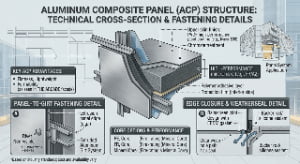
"ACP panel layer composition"
Understanding Core Material Impact
The most critical specification in ACP is core composition, but most RFQs ignore it or just state "fire rated." Here's what we encounter in customer inquiries:
Polyethylene (PE) core: This is standard ACP—lightweight, economical, easy to fabricate into complex shapes. Total panel weight around 5.5 kg/m² for 4mm thickness. But the PE core is combustible, limiting fire rating to B-s1,d0 or lower depending on testing. We supply this for low-rise commercial buildings, retail facades, and renovation projects in regions without strict fire codes. It's 30-40% less expensive than mineral-filled versions.
Fire-retardant (FR) core: Modified PE with flame retardant additives, achieving B-s1,d0 rating in European classification[^5]. This meets requirements for many commercial buildings under 18m height. We see this specified frequently in office buildings, hotels (non-residential), and shopping centers across Middle East and Southeast Asian markets. Cost sits between standard PE and mineral cores.
Mineral-filled core: Non-combustible mineral material (typically aluminum hydroxide[^6]) achieves A2-s1,d0 rating. This allows ACP use on high-rise buildings where regulations permit A2-rated materials (some jurisdictions require only A1, which would force solid sheets). Weight increases to about 6.5-7 kg/m² due to denser core. We quote this when customers need fire performance close to solid sheets but want easier fabrication and lower cost.
A common mistake: Customers request "fire-rated ACP" without specifying which rating class. A contractor once ordered 3000 sqm of FR-core ACP for a project that actually required A2 rating per local code. We caught it during specification review, but if we'd just processed the order, the entire delivery would've been rejected during inspection.
Installation System Differences
ACP panels need different mounting approaches than solid sheets:
Cassette system: Pre-fabricated ACP panels with return edges, installed as complete units onto the subframe. This is our most common system for large commercial projects because installation is fast and weather-tight performance is reliable. Panels are manufactured to exact sizes including returns, shipped ready to clip onto the aluminum subframe.
Rivet/screw fixing: Direct attachment through the panel face into the subframe. Less expensive than cassette systems but creates visible fastener points unless you use decorative caps. We see this method in renovation projects and budget-sensitive applications where concealed fixing isn't critical.
Bonded system: ACP panels adhered to substrate with structural adhesive and mechanical fasteners. This works for retrofit applications over existing walls but requires careful substrate preparation. Installation quality varies significantly based on contractor experience.
| ACP Core Type | Fire Rating | Weight (4mm panel) | Typical Cost Index | When We Recommend It |
|---|---|---|---|---|
| PE standard | B-C class | 5.5 kg/m² | 1.0x (baseline) | Low-rise commercial, non-critical fire zones |
| FR-modified | B-s1,d0 | 5.8 kg/m² | 1.3x | Mid-rise commercial buildings, hotels |
| Mineral-filled | A2-s1,d0 | 6.8 kg/m² | 1.6x | High-rise where A2 rating acceptable |
What Are Aluminum Honeycomb Panels and When Do Large Projects Use Them?
Aluminum honeycomb panels consist of two aluminum face sheets bonded to an aluminum honeycomb core structure, creating a lightweight but extremely rigid sandwich panel.
Honeycomb panels offer the highest strength-to-weight ratio among aluminum cladding types, making them the solution for extra-large panel sizes (over 2000mm length), areas requiring exceptional flatness (curved facades, precision installations), and projects where reducing structural load is critical but solid aluminum strength is needed.
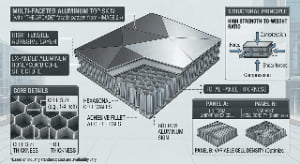 "Honeycomb panel internal structure"
The Engineering Advantage
Honeycomb panels solve a specific problem: How do you create large, flat, rigid panels without excessive weight? The cellular aluminum core provides structural rigidity similar to thicker solid sheets but at significantly lower weight.
Strength comparison: A 25mm honeycomb panel (0.5mm face sheets, aluminum honeycomb core) can span longer distances than 4mm solid aluminum while weighing less—approximately 6-8 kg/m² depending on core density versus 10.8 kg/m² for 4mm solid sheet. We've used honeycomb panels for airport terminal facades where architectural design required 2400mm x 6000mm panels. Solid sheets at that size would've required internal stiffeners, destroying the clean aesthetic.
Flatness requirements: Honeycomb construction resists oil-canning (surface waviness that appears in large, thin metal sheets)[^7]. For projects demanding mirror-finish or metallic coatings where any surface imperfection shows dramatically under changing light, honeycomb panels maintain tighter flatness tolerances. A luxury retail project we supplied required flatness deviation under 0.5mm per meter[^8]—honeycomb was the only aluminum option that met spec without custom tensioning systems.
Weight-sensitive structures: Renovation projects adding facade cladding to buildings with limited structural capacity benefit from honeycomb's lightness. We worked on a historical building retrofit where engineering calculations showed the existing structure could support maximum 8 kg/m² additional load. Honeycomb panels allowed aluminum facade installation where solid sheets would've required expensive structural reinforcement.
Limitations and Cost Factors
Honeycomb panels cost 2-3x more than equivalent ACP and require specialized fabrication:
Edge treatment complexity: The honeycomb core must be sealed during cutting and edge forming. Water intrusion into the core cells causes corrosion and panel failure. Edge sealing requires additional manufacturing steps and quality control that standard ACP doesn't need. We've seen cheaper honeycomb products fail after 2-3 years because inadequate edge sealing allowed moisture penetration.
Fabrication expertise: Not all fabricators can work with honeycomb panels. CNC cutting requires special tooling to prevent core damage. Thermal expansion differences between face sheets and core during bending operations can cause delamination if not done correctly. When customers request honeycomb, we ask about their installer's experience—improper handling during installation can damage panels that were manufactured correctly.
Repair difficulty: If a honeycomb panel gets damaged during installation or service life, you typically replace the entire panel. Solid sheets can sometimes be repaired by beating out dents or patching small areas. Honeycomb structure doesn't allow meaningful field repair.
Fire rating: Aluminum honeycomb core is non-combustible (A1 rated), but the adhesive bonding face sheets to core may limit overall panel rating to A2 depending on adhesive type. Always verify certified test results rather than assuming "all-aluminum" means A1 rating.
| Honeycomb Panel Feature | Performance Advantage | When It Justifies Cost Premium |
|---|---|---|
| Rigidity | Spans 30-50% longer than solid sheet of same weight | Extra-large panels (>2000mm), minimal support requirements |
| Flatness | Surface deviation <0.5mm/m possible | Metallic finishes, reflective coatings, architectural features |
| Weight | 6-8 kg/m² for 25mm thickness vs. 13.5 kg/m² for 5mm solid | Structural load limitations, renovation projects |
| A1 fire rating | Aluminum core + face sheets non-combustible | High-rise applications where weight reduction vs. solid sheet matters |
How Do You Match Panel Type to Your Project Requirements?
Selection decisions happen at the intersection of fire code compliance, structural engineering, and budget reality. I walk through this process with customers dozens of times each month.
Start with non-negotiable requirements (fire rating, wind load, building codes), then evaluate whether multiple panel types can meet those requirements, and finally compare installation system costs and lead times to make the final selection. The cheapest panel material often becomes most expensive when you factor in subframe modifications or certification delays.
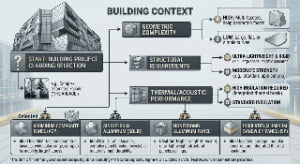 "Panel type selection decision tree"
The Specification Review Process
When a distributor or contractor contacts us with project specifications, we review five items in this sequence:
Building classification and height: This immediately narrows panel options. High-rise residential (definitions vary by country—typically 18-25m+ height threshold) in EU/UK markets requires A2-s1,d0 minimum or A1 rating. That eliminates standard PE-core ACP. Mid-rise commercial (typically up to 18m) can use FR-core ACP with B-s1,d0 rating in many jurisdictions. Low-rise buildings often have no special restrictions.
Applicable fire safety codes: Beyond building height, verify which standard applies. European EN 13501-1 classification[^9] differs from US NFPA 285 testing[^10] or Chinese GB 8624 standards. We hold CE certification (EN standards), ASTM certification (US standards), and Fire Rated A1/A2 certifications[^11], but customers must confirm which certification their project authority accepts. A distributor once ordered A2-rated mineral-core ACP for a Middle East project, then discovered the local authority required NFPA 285 test reports, which use different methodology—we had to provide additional testing documentation.
Wind load calculations: Architectural or engineering drawings should specify design wind pressure in kPa or psf. Coastal regions, high-rise elevations, and exposed building corners see higher pressures. We need this number to recommend panel thickness and mounting system span. If specifications don't include wind load data, we ask customers to have it calculated—we can't quote blindly because undersized panels create liability, while oversized specs waste budget.
Panel size and layout: Larger panels reduce installation labor but increase structural requirements. A facade with 1200mm x 3000mm panels has different subframe spacing and panel thickness needs than one using 1500mm x 4500mm panels. We review architectural elevations to understand typical panel sizes and identify any extra-large feature panels that might need different specification than field panels.
Installation timeline and system: Rush projects favor cassette-system ACP because fabrication and installation are faster than solid sheet cutting and custom mounting. Projects with experienced installers
[^1]: "[PDF] The 2018 International Building Code®: A Compilation of Wind ...", https://www.fema.gov/sites/default/files/2020-07/2018-ibc-compliation-wind-resistant-provisions.pdf. Building codes such as ASCE 7 (US) and Eurocode 1 specify design wind pressures for facades based on location, building height, and exposure category, with high-rise buildings in coastal or exposed areas commonly experiencing design pressures ranging from 1.5 to 4.0 kPa or higher. Evidence role: general_support; source type: education. Supports: that building facades in exposed locations experience significant wind pressures requiring structural consideration. Scope note: Actual design wind pressure requirements vary significantly based on specific location, building geometry, and applicable building code; 2.4 kPa represents a mid-range value rather than a universal threshold.
[^2]: "Failures - Grenfell Tower (Facade) Fire", https://www.engr.psu.edu/ae/thesis/failures/MKP/failures/failures.wikispaces.com/Grenfell_Tower_Facade_Fire.html. Following the June 2017 Grenfell Tower fire in London, the UK government introduced stricter regulations for high-rise residential building facades, including restrictions on combustible materials above 18 meters, with similar regulatory reviews occurring across EU member states. Evidence role: historical_context; source type: government. Supports: that building facade fire safety regulations were strengthened in the UK and EU following the 2017 Grenfell Tower fire. Scope note: This source documents the regulatory response in specific jurisdictions; implementation timelines and specific requirements vary by country.
[^3]: "[PDF] Fire Regulations for buildings with a storey above 18 metres", https://www.epic.uk.com/wp-content/uploads/2018/02/M140-Over-18m-Guide.pdf. UK Building Regulations (Approved Document B) restrict the use of combustible materials in external walls of residential buildings above 18 meters, effectively requiring materials with limited combustibility classifications, while EU member states have implemented varying height thresholds and fire classification requirements under the Construction Products Regulation framework. Evidence role: general_support; source type: government. Supports: that UK and EU regulations impose strict fire rating requirements for high-rise residential facades. Scope note: Specific requirements vary by EU member state and building use classification; the 18-meter threshold is specific to UK regulations and may differ in other jurisdictions.
[^4]: "Aluminium", https://en.wikipedia.org/wiki/Aluminium. Pure aluminum has a density of approximately 2.70 g/cm³ at room temperature, though aluminum alloys used in construction may vary slightly (2.6-2.8 g/cm³) depending on alloying elements. Evidence role: definition; source type: encyclopedia. Supports: the standard density value for aluminum. Scope note: This value represents pure aluminum; commercial aluminum alloys used in cladding panels may have slightly different densities depending on composition.
[^5]: "What B-s1,d0 means for fire-retardant wood - Solid Protect", https://solidprotect.eu/en/Understanding-the-B-s1,d0-Fire-Safety-Classification/. Under EN 13501-1, the classification B-s1,d0 indicates a material with limited combustibility (B class), low smoke production (s1 = limited smoke), and no flaming droplets/particles (d0), representing a mid-level fire performance suitable for many commercial building applications. Evidence role: definition; source type: institution. Supports: the meaning of the B-s1,d0 fire classification designation.
[^6]: "The Effect of Flame Retardant—Aluminum Trihydroxide on Mixed ...", https://pmc.ncbi.nlm.nih.gov/articles/PMC9610015/. Aluminum hydroxide (Al(OH)₃) functions as a flame retardant and smoke suppressant in polymer composites by endothermically decomposing at approximately 180-200°C to release water vapor, which dilutes combustible gases and cools the material, making it a common filler in fire-resistant composite panel cores. Evidence role: mechanism; source type: research. Supports: that aluminum hydroxide (aluminum trihydroxide) is used as a fire-retardant filler in composite panel cores.
[^7]: "What Is Oil Canning? Definition, Causes, & How to Minimize it", https://sheffieldmetals.com/learning-center/what-is-oil-canning/. Oil-canning refers to the visible waviness or buckling that occurs in flat metal panels, particularly thin-gauge sheets with large unsupported areas, caused by stress from thermal expansion, fabrication processes, or inadequate structural rigidity, named for the similar effect when pressing on the bottom of an oil can. Evidence role: definition; source type: education. Supports: the definition and cause of oil-canning in metal panels.
[^8]: "Flatness Tolerances | Hendrick Manufacturing", https://www.hendrickcorp.com/blog/flatness-tolerances/. Architectural metal panel standards such as ASTM E1514 and industry guidelines from organizations like the Metal Construction Association specify flatness tolerances typically ranging from 1-3mm per meter for standard applications, with tolerances below 1mm per meter representing high-precision specifications required for reflective finishes or critical aesthetic applications. Evidence role: general_support; source type: institution. Supports: that sub-millimeter flatness tolerances represent precision specifications for architectural metal panels. Scope note: The 0.5mm/meter tolerance represents a stringent specification; standard commercial panels typically allow greater deviation, and achievable tolerances depend on panel size, material thickness, and fabrication methods.
[^9]: "EN 13501-1 Fire Classification | Performance Classes & Criteria", https://measurlabs.com/blog/en-13501-1-fire-classification-performance-classes-and-criteria/. EN 13501-1 is the European standard that classifies the reaction to fire performance of construction products and building elements, using classifications from A1 (non-combustible) to F (no performance determined), with additional smoke production (s) and flaming droplet (d) ratings. Evidence role: definition; source type: institution. Supports: that EN 13501-1 is the European standard for fire classification of construction products.
[^10]: "[PDF] Flammability tests for regulation of building and construction materials", https://www.fpl.fs.usda.gov/documnts/pdf2022/fpl_2022_hasburgh001.pdf. NFPA 285 (Standard Fire Test Method for Evaluation of Fire Propagation Characteristics of Exterior Wall Assemblies Containing Combustible Components) is a full-scale test method used in the United States to assess vertical and lateral fire spread in multi-story building wall systems, employing different test methodology and acceptance criteria than European reaction-to-fire classifications under EN 13501-1. Evidence role: definition; source type: institution. Supports: that NFPA 285 is a US fire test standard for exterior wall assemblies. Scope note: This describes the test method; materials passing EN 13501-1 classifications do not automatically satisfy NFPA 285 requirements, as the standards evaluate different fire performance characteristics.
[^11]: "Construction Products Directive - Wikipedia", https://en.wikipedia.org/wiki/Construction_Products_Directive. CE marking indicates conformity with EU Construction Products Regulation requirements including harmonized European standards (EN), ASTM standards are consensus technical standards developed by ASTM International widely referenced in North American specifications, and A1/A2 fire ratings are performance classifications under EN 13501-1 requiring testing by notified bodies, representing distinct regulatory and standardization frameworks. Evidence role: general_support; source type: government. Supports: that different regional certification systems govern building material compliance. Scope note: This describes the certification frameworks; specific product certifications must be verified through official documentation and may not be mutually recognized across jurisdictions.